Why business leaders should interrogate their existing commercial engine before investing more in growth.
By Dan Lawrence-Achari | Framework Growth
Executive Abstract
When revenue growth slows, businesses frequently respond by increasing sales and marketing expenditure. But additional investment does not necessarily address the underlying causes of commercial underperformance.
This article proposes an alternative hypothesis: many established businesses have meaningful growth opportunities within their existing commercial infrastructure. These opportunities may exist in customer relationships, acquisition channels, sales processes and resource allocation.
Drawing on research into organizational learning, customer profitability and controlled experimentation, this essay explores why businesses should examine their existing commercial engine before committing additional capital.
The argument is not that spending more is inherently wrong. It is that investment decisions should be informed by evidence rather than assumptions.
The Central Hypothesis
The next meaningful growth opportunity may already exist within the organization. The challenge is identifying, measuring and validating it before committing additional resources.
01. The problem with adding more fuel
One of the first questions businesses ask when growth slows is how much more they should invest in sales and marketing.
I believe that's often the wrong starting point.
Having worked across manufacturing technology, software, financial services, travel technology and artificial intelligence, I've seen how different commercial environments approach growth. Despite their differences, one recurring challenge is the tendency to pursue additional activity before understanding the effectiveness of existing activity.
Consider an established manufacturer.
It has an experienced sales team, a reasonably healthy pipeline, an established customer base and several acquisition channels.
Revenue growth begins to slow.
The conventional response might be to hire another salesperson, increase advertising expenditure or introduce another marketing platform.
But what if the problem isn't insufficient demand?
What if existing quotations aren't being followed up effectively? What if qualified prospects are disappearing somewhere between initial inquiry and the sales conversation? What if the company's largest customers are purchasing only a fraction of the products they could reasonably buy?
Adding resources might generate more activity without resolving the underlying constraint.
Before adding fuel, we should understand how efficiently the engine is running.
This is particularly relevant for established businesses, where existing commercial infrastructure can represent a substantial investment that isn't always being fully utilized.
02. Established businesses have an underappreciated advantage
Startups spend considerable time establishing whether customers want their products, which acquisition channels work and whether their business models are commercially viable.
Established businesses often have information that younger companies are still trying to acquire.
They have:
Existing customer relationships.
Historical transaction and purchasing data.
Experienced commercial teams.
Established distribution networks.
Recognized products and services.
Existing market knowledge.
Operational infrastructure.
These assets can provide a significant starting advantage.
However, possessing these resources and deploying them effectively are two different things.
In his influential 1991 paper, Exploration and Exploitation in Organizational Learning, James G. March examines the tension between developing new opportunities and refining existing capabilities.
His research highlights the organizational challenge of allocating resources between exploration and exploitation.
I find this particularly relevant to established businesses.
Organizations can become very good at optimizing what they already do, while overlooking opportunities to challenge existing assumptions.
Equally, they can become distracted by new initiatives without fully exploiting their existing capabilities.
The commercial challenge is finding the right balance.
Read March's original research — Organization Science (1991)
The implication: Established businesses shouldn't automatically adopt the spending patterns of startups. They should examine the commercial advantages they've already built and determine where those advantages remain underutilized.
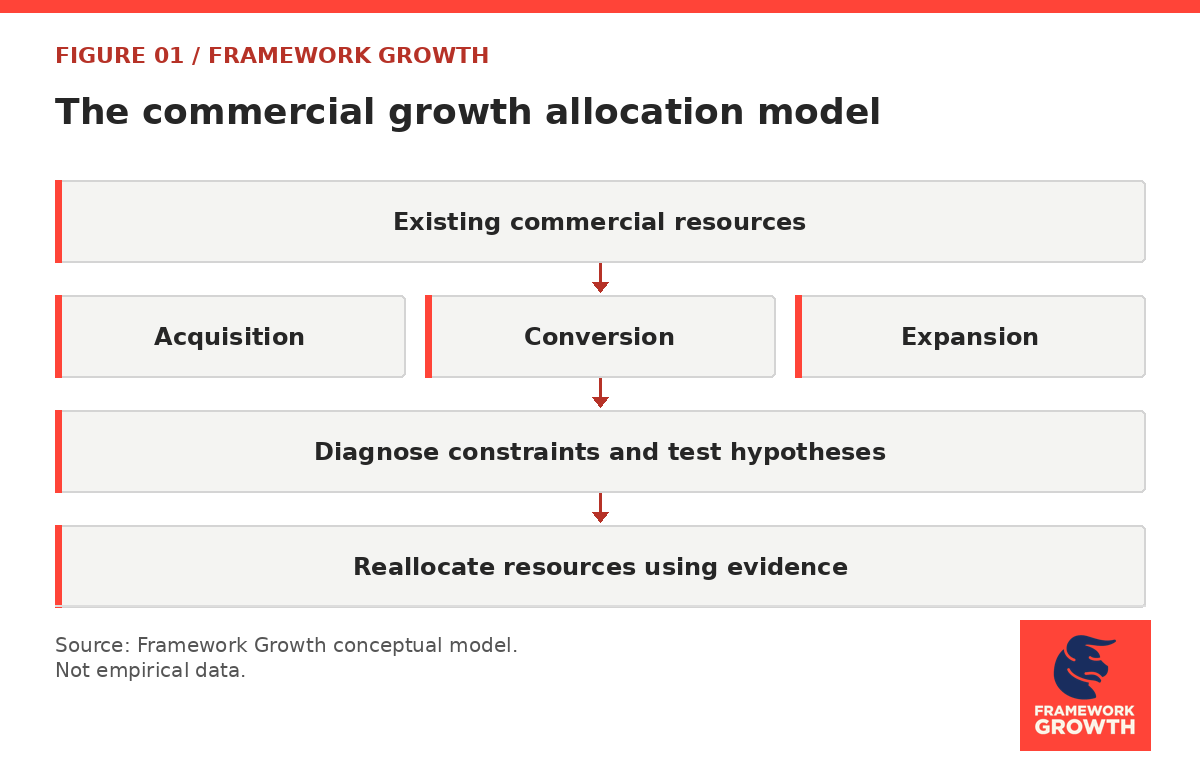
03. Three hypotheses worth testing
Rather than assuming every business needs more marketing expenditure, I would begin by examining three areas.
Hypothesis 1: Existing customers represent an underutilized growth channel
Consider an industrial distributor with hundreds of active customer accounts.
Instead of immediately pursuing new customers, the business could examine purchasing patterns across its existing accounts.
Which customers purchase from only one product category?
Which previously active accounts have reduced their order frequency?
Which customers have requirements the distributor could already fulfill?
A focused cross-selling or reactivation experiment could establish whether these opportunities are commercially meaningful.
However, there's an important distinction.
Existing customers aren't automatically more profitable customers.
Research by Werner Reinartz and V. Kumar, published in the Journal of Marketing in 2000, challenges the assumption that customer longevity necessarily translates into higher profitability.
Their research, conducted in a noncontractual catalog retail setting, found that long-standing customers were not necessarily the most profitable.
This is an important consideration.
The objective shouldn't simply be to sell more to existing customers. It should be to identify customers and opportunities with attractive commercial economics.
Read the original research — On the Profitability of Long-Life Customers (2000)
Proposed experiment:
Select a segment of existing customers with identifiable product category gaps.
Develop a targeted cross-selling proposition and measure:
Incremental revenue.
Gross margin.
Conversion rate.
Average order value.
Cost of execution.
Compare the results against an appropriate baseline or comparison group.
The objective is to determine whether account expansion represents a repeatable and profitable opportunity.
Hypothesis 2: Commercial bottlenecks are suppressing the return on existing investment
A business may have several acquisition channels operating simultaneously:
Outbound sales.
Referrals.
Distributor relationships.
Trade shows.
Digital marketing.
Inbound enquiries.
Each channel generates activity.
But activity alone tells us relatively little about commercial effectiveness.
The more useful questions are:
Where are qualified opportunities being lost?
How long does it take to respond to a new inquiry?
What percentage of quotations become orders?
Which channels generate profitable customers?
Where does the sales process create unnecessary friction?
For manufacturers and distributors, quotation management can be particularly interesting.
A business may generate a substantial volume of commercial quotations without having a consistent process for tracking, prioritizing and following up on them.
That creates a testable hypothesis: improving quotation follow-up could increase conversion without increasing quotation volume.
Proposed experiment:
Establish the existing quote-to-order conversion rate.
Introduce a structured follow-up process for a defined segment of outstanding quotations.
Compare the conversion rate, response time and resulting gross margin against the existing process.
The objective is to establish whether the improvement is commercially meaningful and repeatable.
Hypothesis 3: Small experiments can improve large investment decisions
Growth initiatives are frequently evaluated through business cases built on assumptions.
There is nothing inherently wrong with forecasting.
The problem arises when forecasts substitute for evidence that could reasonably be obtained through testing.
In their 2009 research paper, Controlled Experiments on the Web: Survey and Practical Guide, Ron Kohavi and colleagues examine the application of controlled experiments to business and digital environments.
Their work highlights the importance of experimental design, measurement, sample size and statistical power when evaluating changes in user behavior.
Although their focus is online experimentation, the underlying discipline has broader relevance: define the hypothesis, determine what constitutes success, establish a suitable comparison and evaluate the evidence.
Read the original research — Kohavi et al. (2009)
Before committing to a new market, expanding a sales team or introducing a new acquisition channel, leadership should ask whether a smaller experiment could reduce uncertainty.
A targeted outreach campaign, revised sales proposition or controlled customer expansion initiative might provide useful evidence before a larger investment decision.
The purpose of experimentation isn't simply to find quick wins.
It is to improve capital allocation.
04. What happens when you improve the existing commercial engine?
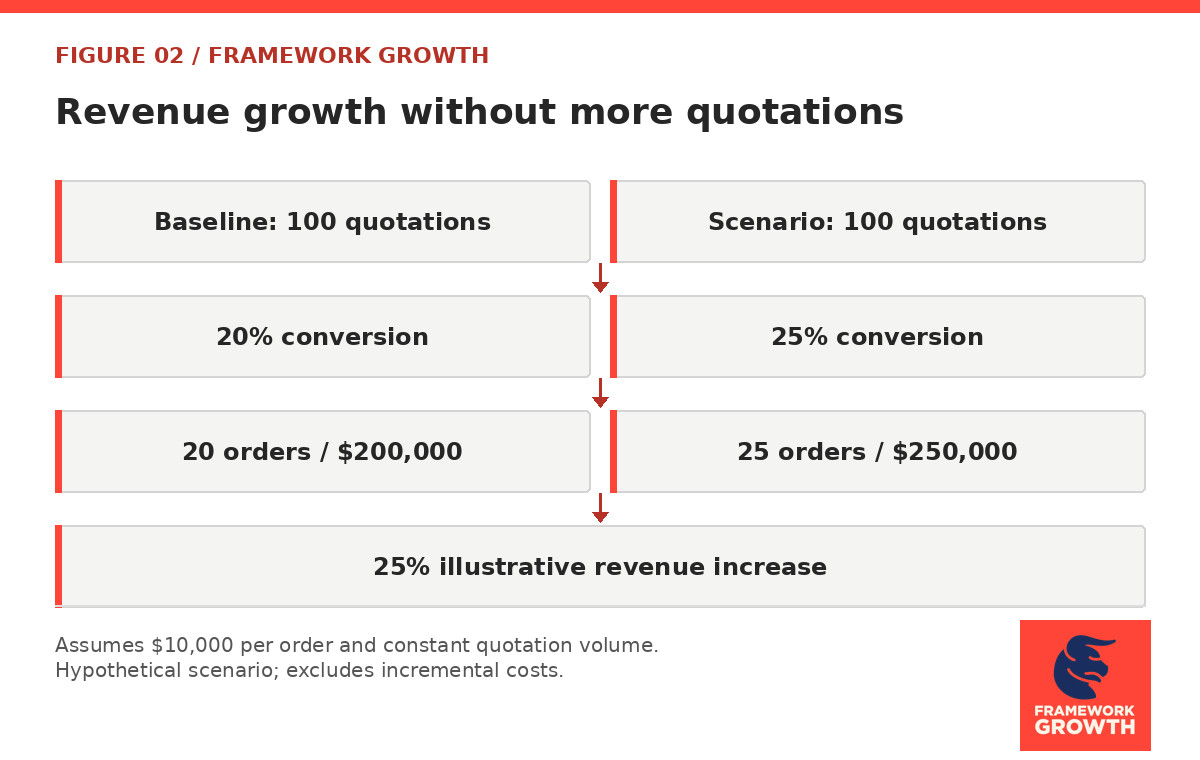
Consider a hypothetical manufacturing business.
It generates 100 sales quotations per month, with an average order value of $10,000.
Its existing quote-to-order conversion rate is 20%.
That produces:
100 quotations.
20 orders.
$200,000 in monthly order value.
Now imagine the business improves conversion from 20% to 25%, without increasing quotation volume or average order value.
The result becomes:
100 quotations.
25 orders.
$250,000 in monthly order value.
That's a hypothetical 25% increase in order value from the same quotation volume.
The example is deliberately simple.
In practice, we would need to account for gross margin, sales cycle, cancellations, fulfillment capacity, seasonality and the cost of improving conversion.
But it demonstrates an important principle:
Growth doesn't always require more activity. Sometimes it requires better performance from the activity already taking place.
05. A practical framework for leadership teams
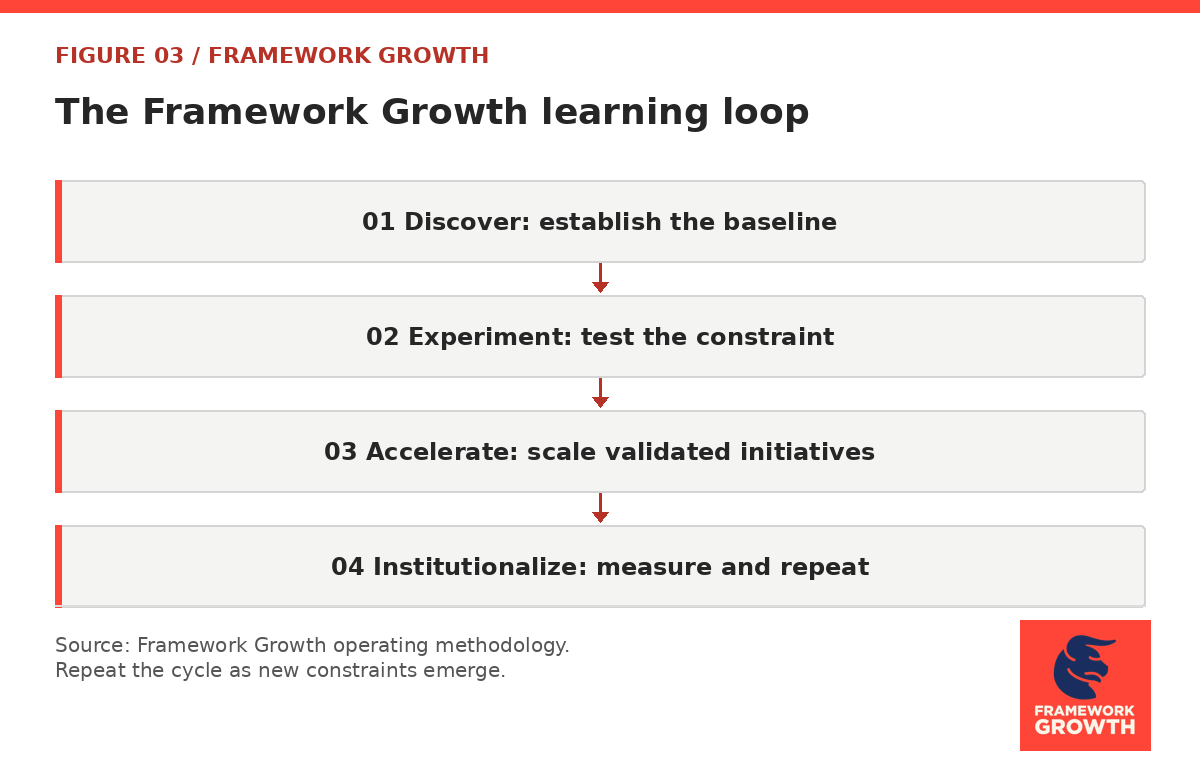
Before approving additional growth expenditure, I would encourage leadership teams to work through five questions.
1. Establish the baseline
What is the existing commercial engine producing, and at what cost?
Understand revenue by channel, customer profitability, pipeline performance, conversion rates and retention.
Without a baseline, it's difficult to determine whether an initiative has actually improved performance.
2. Identify the constraint
Where is the greatest commercially meaningful bottleneck?
It might be acquisition, conversion, customer retention, account expansion or operational capacity.
Don't assume the most visible problem is necessarily the most important one.
3. Develop a hypothesis
What do we believe is causing the underperformance?
Be specific.
For example:
"We believe that a structured follow-up process for outstanding quotations will improve quote-to-order conversion among a defined customer segment."
This is more useful than simply saying the business needs to improve sales.
4. Run a focused experiment
What is the smallest practical test capable of producing useful evidence?
Define the target segment, implementation process, duration, success metrics and comparison method before beginning.
The experiment should be designed around the actual commercial question.
5. Allocate resources accordingly
Should we scale, refine or discontinue the initiative?
If the evidence supports the hypothesis, determine whether the initiative can be repeated profitably.
If it doesn't, understand why.
The result should inform the next investment decision.
This process should be repeated as the organization learns.
Importantly, success criteria should be established before the experiment begins. Otherwise, there is a risk of interpreting almost any outcome as evidence of success.
06. When additional investment is the right answer
There are, of course, circumstances where growth genuinely requires additional capital.
A manufacturer operating at full production capacity may need new equipment.
A business entering a new geographic market may require local commercial infrastructure.
A company with a validated acquisition channel may benefit from increasing its investment.
An organization with insufficient sales capacity may genuinely need additional commercial resources.
Experimentation cannot eliminate structural constraints or replace necessary investment.
It can, however, help leadership distinguish between an opportunity that requires more resources and an existing resource that could be deployed more effectively.
There are also limitations to the experimentation approach itself.
Some commercial decisions involve long sales cycles, small customer populations or significant external variables. Not every initiative can be evaluated through a short controlled experiment.
A two-week test may provide directional evidence, but it may not establish a reliable commercial outcome.
The appropriate measurement period depends on the business model, sample size, customer behavior and economic significance of the decision.
The objective is not to experiment for the sake of experimentation.
It is to improve the quality of commercial decisions.
07. A different starting point
I don't believe businesses should avoid spending money on growth.
I believe they should become more deliberate about when, where and why they spend it.
Having built businesses, worked across different industries and been involved in commercial growth initiatives, I've come to appreciate the importance of understanding the underlying economics before recommending additional activity.
The most interesting growth opportunities aren't always the most obvious ones.
Sometimes they're hidden in existing customer relationships, underperforming channels, overlooked commercial processes or assumptions that nobody has challenged.
The next time revenue growth slows, perhaps the first question shouldn't be:
How much more should we invest?
Perhaps it should be:
What haven't we learned about the commercial engine we already have?
The answer may reveal opportunities that were overlooked while the organization was looking elsewhere.
References & Further Reading
[1] Organizational Learning
March, J. G. (1991). Exploration and Exploitation in Organizational Learning. Organization Science, 2(1), 71–87.
[2] Customer Profitability
Reinartz, W. J., & Kumar, V. (2000). On the Profitability of Long-Life Customers in a Noncontractual Setting: An Empirical Investigation and Implications for Marketing. Journal of Marketing, 64(4), 17–35.
[3] Controlled Experimentation
Kohavi, R., Longbotham, R., Sommerfield, D., & Henne, R. M. (2009). Controlled Experiments on the Web: Survey and Practical Guide. Data Mining and Knowledge Discovery, 18, 140–181.
About the Author
Dan Lawrence-Achari, previously known professionally as Dan Lawrence, is the founder of Framework Growth.
He brings more than 15 years of broader growth and marketing experience, with a professional background spanning manufacturing technology, entrepreneurship, travel technology and artificial intelligence.
His experience includes commercial growth leadership at Simutech Multimedia, founding and scaling RemoteCasa across six countries, and work in AI commercialization at Atlis.
Through Framework Growth, Dan works with business owners, executives and investors to identify overlooked commercial opportunities, validate growth hypotheses and build sustainable business performance.
Explore Dan's professional background
Continue the conversation
Where is your next growth opportunity hiding?
Framework Growth works alongside business owners, executives and investors to uncover commercial opportunities, test high-potential initiatives and turn validated strategies into sustainable business performance.
Discuss Your Growth Priorities
Framework Growth / Research & Perspectives